In 2007, when he was a young pastor at a church plant in Salem, Oregon, the Rev. D.J. Vincent noticed that a group of unhoused people had been living in Cascades Gateway Park. He and his parishioners wanted to do something to help them out and settled on a simple idea: They’d host a potluck.
That impulse to share a single meal started a ministry that has grown into a multimillion-dollar nonprofit called Church @ the Park. It now offers outreach services, workforce development, emergency shelter and permanent housing to the area’s unhoused population. In 2024 they served nearly 2,000 people across six locations.
As Church @ the Park evolved, so too did Vincent’s approach to ministry. From his conversations with unhoused folks at the meals, he gained a new perspective about dignity, humility and relationships. He felt he needed to change the way he was thinking about his service work; in looking for guidance he came across Street Psalms, a faith-based organization committed to developing strong community leaders.

The organization, a network of more than 40 organizations in 100 cities around the world, was formed to help create “communities in mission” that foster human flourishing in urban spaces. Street Psalms is based on “theology from below” — that is, learning alongside people at the margins rather than imposing solutions from above. This approach aligned with Vincent’s experience at the potlucks.

“The spirit of God exists in this community, and we had to learn how to listen,” Vincent said. “I started to see how important it is to do things with people, not just for people.”
In Street Psalms, Vincent found an enriching framework for serving his community. The organization promotes cities of peace, with a special emphasis on caring for the most vulnerable. Their approach is like a fungal ecosystem. Mushrooms are the fruit of an intricate network of mycelia, the thread-like roots that connect trees, share nutrients, and create the conditions for new life to flourish. Church @ the Park is one of the mushrooms, and Street Psalms is the underground network of relationships and shared wisdom that makes it possible.
“Street Psalms created a bubble of belonging for us,” Vincent said. “They value connectedness and relationship, and our organizational values are the Street Psalms values. We aren’t just a place for people to get resources, but where they can find value and dignity and responsibility.”
Learning to be peacemakers
Street Psalms calls itself a “sodal” expression of the church, as opposed to a more traditional “modal” one. “Sodal” comes from the Latin “sodalitas,” meaning “companion” or “partner.” The organization uses this description to explain how it seeks to develop leaders who are embedded in vulnerable urban communities, people who are trying to enact meaningful change in their cities.
“We’re an urban monastery without walls,” said Sarah Moore, Street Psalms’ senior fellow for applied research, who came to the organization after a career as a psychology professor. “We prepare people for the challenges they face out in the real world of service.”
What are the invisible or less visible support networks that help your ministry thrive?

They teach a set of questions they call the Incarnational Framework, based on four concepts that go by the shorthand “See, Do, Be, Free.” It starts with three questions:
- Does your way of seeing call you out of the myth of scarcity and into the reality of abundance?
- Does your way of doing call you out of theory and into practice?
- Does your way of being call you out of rivalry and into peacemaking?
Living according to these three values — prioritizing abundance over scarcity, action over ideas, peacemaking over rivalry — leads to the end goal of nurturing a comprehensive sense of “gospel freedom,” one founded in love, mercy and service. It’s the capacity to act without reacting and to live in accordance with the Spirit, not just self-interest. The framework is used as part of a training guide and is a diagnostic tool to help leaders examine their own approach to transforming their communities.
“The framework is very much a part of what I’m doing as a pastor and what I want our congregation to become,” said the Rev. Lina Thompson, pastor at Lake Burien Presbyterian Church, just south of Seattle. Thompson, who is on the
Street Psalms staff, leans on the framework in all aspects of her work. “I go into weekly meetings and think about abundance and about how we can be peacemakers.”


Forming leaders who serve communities
Thompson has been with Street Psalms since it was founded in the 1990s. The organization initially served urban youth workers in Philadelphia and was an initiative of the Pew Charitable Trust. Kris Rocke, the current executive director, had written a curriculum for World Vision, a youth mentorship organization, and he realized that the leadership skills it cultivated could be applied to anyone looking to share the “good news in hard places.” In 2023, Street Psalms officially became a religious order.
“Our charism has crystallized, especially over the past eight years,” Thompson said. “We’re committed to the formation of leaders who are serving their communities. It takes a special kind of spirituality to do this work, and we realized people weren’t getting the training they needed in a more formal seminary.”
While Street Psalms has always mentored leaders in their specific contexts, its programming and curriculum has become more formalized and refined over the years. Its nontraditional seminary is not affiliated with a denomination and does not ordain pastors for local churches. Instead, it trains people to lead communities in mission. It ordained its first cohort of leaders in 2010.
Who is accompanying the vulnerable people in your community? How are they supported or connected?
“We say we’re joyfully unaccredited,” Moore said. “While we do not believe, not at all, that this replaces formalized and accredited seminary training, we do believe that this offers the type of transformational experience that prepares leaders to serve the sodal form of the church.”
Street Psalms offers a one-year novitiate program that ends in ordination. Through daily, weekly, and monthly rhythms and practices, as well as synchronous and asynchronous classes and workshops, ordinands learn the Incarnational Framework and how to employ it in their communities. Nearly 40 people around the globe have been ordained. The organization also has a one-year fellowship program that finances specific community projects. Funded by grants from large and small benefactors, it gives all of its materials away for free.
The program is rooted in a specific hermeneutic, a way of reading the Bible that prioritizes and centers the most vulnerable people in Bible stories and parables.
“What you practice with Street Psalms is a way of reading Scripture from below, from the perspective of the marginalized,” Thompson said.
“During my formal training for my M.Div., nobody helped me see that the context of Scripture is about people who were oppressed,” she said. “It’s written to tell that story, but you very rarely hear that. The Lord’s Prayer, for example, came about during the context of the Roman Empire. When you think about it like that it gives it a new resonance.”
Learning to read with this lens prepares leaders in urban communities to ask questions of the text that might unlock new significance for its constituents and to be open to new and surprising interpretations.
“One of the big things the church doesn’t talk enough about, that Street Psalms does talk about, is violence,” Thompson said. “It’s not just physical violence, either. It can be the political thing and the pressure to pick sides.
“With Street Psalms, we want to curate the kind of conversations that don’t create enemies on the other side. I don’t know where I’d be as a preacher or as a spiritual leader if I didn’t have this framework.”
What is the role of relationships and trust in making change in your community?
Building ‘communities in mission’ around the globe
Street Psalms trains leaders to love their city and seek peace in it, which entails learning how to listen to their city’s “sacred song”— the literal meaning of “psalm.”
“With the name, you have two images coming together and resonating,” Thompson said. “’Street’ says, ‘I’m here,’ ‘I’m with my community.’ And ‘Psalms’ is all the joy and lament that you find there. All the raw ways history shows up through our people.”
The organization takes different forms with all its partners; every mushroom that blooms from the network is unique. These partners do many kinds of work, from homeless outreach to after-school programs to helping survivors of domestic abuse and walking with people coming out of prison. And they’re all over the globe.
When an organization commits to following the Incarnational Framework, it becomes a “community in mission,” which in the simplest terms means that it shares the See, Do, Be, Free philosophy and can tap into a web of support when it needs help navigating challenges that can arise when doing things with people and not just for them.
“We’re kind of like the wholesalers,” Moore said. “And our partners are the retailers.”
Changing the way leaders engage with the world
In addition to the seminary, Street Psalms runs a design studio that functions as a kind of incubator for innovative social change. Partners can put their ideas through their paces before testing them out in the world.
One idea that came out of this is the Preaching Peace Initiative. At gatherings called “Tables,” partners tackle issues that pertain to their communities using the Incarnational Framework and the “theology from below” hermeneutic. Thompson visited a Table at one of Street Psalms’ partners in Kenya.
“In Nairobi there was a Preaching Peace Table with Christian pastors and Muslim clerics, and they took a common theme and discussed it from their different perspectives,” she said, adding that there had been violence between these communities in the past.
“The theme was: ‘What does it mean to love your neighbor?’ So you get in this room and you see the kind of conversation about peace. It helped foster these ideas of abundance and peacemaking and asked what it would look like for that to exist there, in that community.”
Thompson likened that work to what Vincent is doing with Church @ the Park.
“They have a clear picture of what it means to serve the most vulnerable,” she said. “They have a common language of scarcity and abundance and what it means to work across difference for the sake of the poor.”
Which of the four ideas of the framework (See, Do, Be, Free) speaks into your current ministry moment?

During the early potlucks, Vincent saw problems to be solved, needs to be met, deficits to be addressed — what he regards now as classic scarcity thinking. But as he listened to the people he was serving, he learned to see differently. His perspective shifted to one of abundance and collaboration. And he understood that the community already had what it needed to flourish.
“We grew into a ministry of mutuality, where folks can find not only resources, but value and dignity,” he said. “The goal is co-creating a better reality, and we are our best selves in community, not in isolation.”
Vincent now takes all of Church @ the Park’s staff through a version of the Incarnational Framework during their training. He wants the organization to be as inclusive as possible, serving people regardless of their faith background, sexual orientation, gender identity or any other typical dividing line. More than half of the employees don’t identify as religious, but they’ve found a sense of belonging in the organization and its mission for peace and relational abundance. This kind of radical acceptance and baseline humility is what helps make Street Psalms unique.
“It’s more than a curriculum or content,” Moore said. “If you embrace the framework, it changes the way you engage with the world.”
How does a scarcity mindset make change more difficult in your congregation or community? Where does an abundance mindset offer new opportunities?
Questions to consider
- What are the invisible or less visible support networks that help your ministry thrive?
- Who is accompanying the vulnerable people in your community? How are they supported or connected?
- What is the role of relationships and trust in making change in your community?
- Which of the four ideas of the framework (See, Do, Be, Free) speaks into your current ministry moment?
- How does a scarcity mindset make change more difficult in your congregation or community? Where does an abundance mindset offer new opportunities?
Keri L. Day sees a unique space in theological education for Black students and professors, and it contributed to the title of her new book.
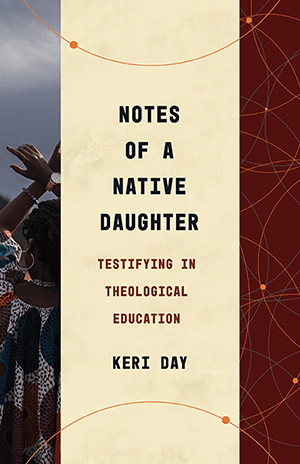
The associate professor at Princeton Theological Seminary wrote “Notes of a Native Daughter: Testifying in Theological Education” as part of the Theological Education Between the Times series. One of the things she explores is the presence of both harm and hope in the academy.
“[There are] both the deep experiences of structural racism and a number of Black students as well as faculty members knowing that they have contributed and they have shaped theological education in profoundly important ways,” Day said.
“It seemed to me that either privileging one or the other side is sort of helpless and hopeless, because structural racism does not allow, or will not allow, African Americans to lean into their call and into their own talents and gifts.”
Day offers a third perspective — which she believes most Black faculty and students feel — that they are both insiders and outsiders, “kin and yet strangers,” in the theological academy.
She compares it to the experiences James Baldwin wrote about in “Notes of a Native Son.”
“He knew, as an African American, we’ve contributed in making America what it is. But at the same time, we still felt excluded. We still felt outside of what America offered,” she said. “I felt like this ‘Notes of a Native Daughter,’ particularly focusing on Black women’s experiences and Black queer people, that it captured this contradictory, liminal space that African Americans find themselves in.”
She spoke with Faith & Leadership’s Aleta Payne about her book. The following is an edited transcript.
Faith & Leadership: You write about how the theological academy is “a site of both harm and hope,” a site of both repression and affirmation, for racially marginalized groups. That is such a powerful image. Can you talk about it a bit more?
Keri Day: I’m thinking, for example, of how African American students come to the theological academy, say to Princeton Theological Seminary. On the one hand, they feel at times not heard, not seen, because the theologians that they’re studying are white, with particular kinds of experiences that are not their own cultural experiences. Or particular points that they make on a theological level do not resonate with those in the primarily dominant white class.
They feel themselves as needing to not just be understood but to prove themselves, that they too can participate in the intellectual “world building,” as we would call it in the context of theological education. That’s harm, a site of harm. It’s a site or a context where African American students and faculty begin to question themselves, their abilities to move through the context — what can they actually contribute to the context — because they feel so inadequate.
On the other hand, it’s also been a site of hope. The same students that come from the Princeton Theological Seminary will find themselves deeply tooled by classes that they’ve taken. Maybe they’ve come out of a church that is deeply conservative and doesn’t support Black women in ministry, does not support Black queer people. When they come to the seminary, they’re able to find and discover intellectual and theological tools that will allow them to make a case, to speak and affirm their own perspectives, and maybe those perspectives are not embraced within the context of the Black church or within the context of Black community.
In that way, it’s a site of hope, because here they do feel confirmed in their perspective. They do feel affirmed that they’re wanting to think more progressively about the world around them and about different experiences along lines of gender and sexuality. Here you have, again, this double consciousness that W.E.B. Du Bois speaks about — that they experience theological education on the one hand as still repressive in these kinds of ways that I mentioned but on the other hand as a site of profound possibility.
F&L: You have described parts of your book as a testimony. For those who do not know what it is to testify or understand what a rich and powerful part that is of some people’s theological experience, can you explain it?
KD: In this tradition that I grew up in, what made testifying so powerful was that it certainly is an individual act, in the sense that the individual is standing and declaring one’s own truth. In the moment of testifying, you are speaking your truth, your experience of God and the divine, your experience of the world, who you are.
There might be some people in the room who may not like what you’re declaring about what God has done for you or what you’ve experienced by way of struggles and victories through the week as you stand up in church and you basically speak what your experience has been with God and with the world and with yourself. But here you are. It’s a profoundly individual act.
But here is the key to the power of testifying and testimony: it is not only an individual speaking one’s truth; testifying is also a collective act. Part of what grants testifying or testimony its power is that presumably there is an audience or community on the other end that is waiting to hear and move into the experience with you.
When one got up in my tradition and testified to what God had done, one also knew that what made it a powerful moment is the community affirming by way of oohs and aahs, by way of saying “Amen,” by way of saying, “You better tell it!”
This call-and-response format is a way of the community affirming for individuals that they are heard, that their experience is valid, that basically the individual is right in speaking the truth that he or she knows to be true.
For me, the power at a metaphorical level, in my book of testimony and talking about theological education, is that part of what the theological academy has to do is be that community who is willing to participate in this powerful ethical moment. Not just a theological moment. It’s an ethical moment of affirming that what the individual — in this case, the native daughter, the native son, the African American student or faculty — that what they speak is important, that it needs to be heard, that it needs to be affirmed.
When it is heard, when it is affirmed in a collective manner, then that testimony becomes a form of knowledge about who we are as a community literally — not just about who I am as an individual speaker but about who we are. It becomes the truth of the collective, something that needs to be lived into by the community.
F&L: You end this book where you could not possibly have known you would when you began — in the pandemic. How do you think that made it different?
KD: I started this book a year and something before the pandemic hit, and in some ways I did have to go back and I had to reframe the book based on the pandemic. Because to me, it was in the pandemic that I was able to see in some ways the unrelenting nature of structural oppression. The pandemic more deeply exposed the unrelenting burden of structural racism on Black community, on Black students within theological education, on Black faculty.
I want to be clear: it doesn’t mean that other faculty who are not Black didn’t have issues. But what I am saying, as an example, is that I had a number of my students that come from communities that were hard hit by the pandemic because their communities have few resources, so they were more vulnerable. They were more susceptible to COVID. Many of them, Black students, had family members who lived in more economically disadvantaged neighborhoods and had COVID and were in serious condition, and [I saw] the burden that placed on these students, in the middle of online education, to perform.
They would come to me about their white professors, some of the very problematic responses in pedagogies that were operating, and in some ways a lack of desire by some professors to really understand the community that these students come out of and how their academic performance is actually affected by being Black in America, basically. It actually did call upon me to go back and to reshape some of what I wrote.
The postscript that I wrote to the book, the last few pages, I went back around to put the question mark back in the air. You get the sense that in the fourth chapter it is a prayer that I have of community, of theological education listening to native daughters and sons, of a kind of great gathering, of a beloved community.
But as a postscript, when I started writing about the pandemic, the question mark reemerges. Is it possible? It’s this sort of tension that I do want the reader to live inside of, where I talk about having students that felt like they were the problem. They were treated as if they were a problem because of all they were going through, given the community that they are a part of and how disproportionately these communities were affected, and them needing to balance what they do academically with this reality of their community and their family.
All of that brings back, Is it possible for theological education to truly listen? The question mark, again, reemerges. It’s this tension of what I was hoping to accomplish in the text. This tension reemerging by the time the reader ends the book, the postscript, that the theological academy is a site of both harm and hope.
F&L: What else would you like people to know about this book, about the process, or about what you hope they will take away from it?
KD: To the president and the dean of a theological institution, you must no longer take on a managerial position when it comes to the institution, just managing the institution according to what has happened in the past, just trying to preserve what the institution has been. To the president and the dean, after reading this book, I hope you take away that you must have bold, risk-taking vision in helping to release theological education into a more liberative future as it relates to race and gender.
To the faculty, to the faculty of color, to the Black faculty, testify. That in and of itself is often very hard and can be a dangerous thing if you’re on tenure track. But find ways to testify. Sometimes it’s therapeutic to ourselves to be able to just testify in safe spaces.
To the white faculty member, truly become an ally, as I talk about in this book, by attending to the policies and the structures of the institutions. It’s not enough to speak that I’m an ally or I have a good Black girlfriend or he is a good colleague of mine at my institution. Really stand up in the policy decision making of the institution and promote equity for Black students and Black faculty.
To the prospective student that wants to enroll in theological education, the groundwork has been laid down. We’re standing on the shoulders of others who in some way — and I don’t know if you can see this in my text, but I really try to give honor to those who have come before. I’m not just talking about what it means to be Black in theological education or a Black woman, but I’m also telling a story about how Black women have actually shaped theological education. I want the prospective student — white, Black, it doesn’t matter what ethnicity or race — I want them to be able to see that, to acknowledge that and to celebrate that.
The Rev. Rhonda Thomas already had plenty on her plate as executive director of Faith in Florida.
Her organization, which falls under the national umbrella of Faith in Action, worked on issues of discrimination and disenfranchisement across a broad swath of the state. There was plenty going on before legislation was passed limiting what can be taught, said or read in the state’s K-12 public schools, as well as in its colleges and universities. The consequences have extended nationally to the College Board and beyond.
In Florida, Thomas and others have led a countermovement that has mobilized faith communities to teach what the public schools cannot. Faith in Florida has launched a multipart toolkit focused on topics like race, racism and whiteness, and Black women in leadership, centering faith communities as critical to providing accurate information and anti-racist formation.
Thomas spoke with Faith & Leadership’s Aleta Payne about the effort, which has broadened to other states. The following is an edited transcript.
Faith & Leadership: Could you talk a bit about Faith in Florida?
Rhonda Thomas: We fall under the umbrella of our national [network], which is Faith in Action, and we organize in 41 counties in the state of Florida — multiracial, multifaith leaders working around racial, social and economic justice. We have [statewide] campaigns that we organize, which are immigration, reducing gun violence and mass incarceration, and protecting democracy.
In those counties, we also have our local issues we organize around, whether it be public education, housing, living wages, that sort of thing. That’s who Faith in Florida is. It’s a faith-based organization that just cares about people that are impacted by all sorts of [issues], whether it be legislation, those who have been disenfranchised, those who have been discriminated against — really, really caring about marginalized communities and people in general.
Many people don’t really see Florida as being the South, unfortunately. I don’t know if they get caught up in the tourism or the beaches, the entertainment, the food, but we’re very much the South and as impacted as many other Southern states when it comes to this fight that we’re in.
F&L: How and why did you come to develop the pledge and toolkit around teaching Black history?
RT: We realized that there was an attack on public education as well as our universities on how African American history was being taught in the curriculum and that it was recommended and legislated that it be taught in a watered-down version, implying things that were not true, such as Black people benefited from being slaves.
Faith in Florida decided to do what we do, and that’s organize — organize our faith leaders and see if they will commit to teaching African American history in its realness. You cannot water down history. It is history. I felt personally that our educators were professional enough, whether it be from a public school system or from a university, that they would teach African American history in a way that it was not targeted to offend any race. It would be taught in a professional way through a curriculum that was created.
We felt like, “We’ll take it back to where it originated.” And that’s the Black church, because that history still sits in our pews. That history is still real, and it’s alive. We have always taught our history, maybe not through a curriculum, but we’ve taught it in living color.
I asked my research coordinator to create a team within our staff where we would be able to have resources, whether books or documentaries, that would give our churches the liberty to choose from the toolkit, understanding that we were creating a toolkit that will offer a variety of resources that they can choose from that can fit their own congregations.
It also is a toolkit that will be able to accommodate all ages of people, whether it is children, adults, whether they’re in the church or visiting or never attend but care about the teachings of Black history.
That’s where it all came from. Horrible legislation that came through the state of Florida. We saw where it was not right in the lenses of Black people. The toolkit also gave our faith leaders the liberation to teach it, because the Black church has always been and still is very creative in the way we teach.
It could be taught through biblical lenses, and it could be taught through art, through dance, through music, because that’s just who we’re made up of. Because we organized multiracial, multifaith leaders and congregations, then some of our white churches and mosques, they were like, “We see this is morally wrong. We understand that we may not be able to teach Black history like the Black church can, but we can teach it in a way of accountability.” And that came from our white congregations and white faith leaders. Our Muslim [leaders] understood that we have more in common than what separates us in the way we connect together as a whole. They were willing to teach Black history as well, but still understanding that no one can do it like the Black church can.
F&L: You see this as a moral issue that extends beyond Black Christians.
RT: Yes. We had an open discussion through one of our statewide clergy calls. To try to erase or water down [anyone’s history], to be watered down in a version where it does not represent the truth — it’s morally wrong.
And then Black history itself, recognizing that if we’re not deliberately teaching it in the right form, it also opens [the possibility of] history being repeated, which I do see happening in this country, and definitely in the state of Florida. It’s being repeated. We look at it in the way of how voter suppression still exists. Black people no longer have to go to the supervisor of elections office to guess how many jelly beans are in a jar; now our voting rights are being oppressed and suppressed in the way of [formerly incarcerated] citizens not having the opportunity to register to vote once they’ve served their time in the state of Florida.
F&L: While you started this curriculum for Florida, you have had enough interest from outside the state that there is an effort to broaden it.
RT: My goal was strictly the state of Florida and how do I get 500 congregations to take the pledge to teach African American history. Twenty-eight other states have now joined Faith in Florida under our leadership and are using our toolkit in teaching Black history — 28 states. That was not my goal or vision, but unfortunately, states all across this country were [thinking that] what happens in Florida can possibly happen in their states.
F&L: What do you hope other faith leaders in those states might take from this effort? What do you hope they might take forward?
RT: What has happened here has united faith leaders of many denominations. It has united us under one umbrella to see the importance of Black history being taught. I say it’s being taught raw and being taught real. It is not being taught in a way to offend anyone. If we want to talk about being offended — Black people, we have been offended since the beginning of time. As a Black woman, I would never want to teach anything that would offend others, because I know what that feels like. Seeing the importance of Black history being taught in its own authentic way, we’re uniting communities as well in a faith space, and then also recognizing that we’re operating in the power and the authority that God has given us.
F&L: Is there anything else you want people to know about this work?
RT: This work is great. This work is good, and it’s worth it. You have not asked me whether there has been any resistance. One of our churches has received a bomb threat that came through the police department. Some of our churches are getting called: “Why are you doing this?”
In my church, we have a safety plan in place, even to the point of having active shooter trainings. It’s just unfortunate that this is the way we are looking at how we protect not just the Black church.
Like I said, we organize multiracial, multifaith. There are threats not just on the Black church. Our Jewish community, they’ve gotten threats as well in the synagogues. Our mosques are getting threats. So it also takes us to a place that we have more in common than what separates us when it comes to the faith community.
I don’t think that’s ordained by God, based on my faith tradition, that we should be worshipping in a way that we need to protect ourselves and not be able to worship. Where the spirit of the Lord is, there is liberty. But this is the time we’re living in.
My encounter with Tim Keller, who died May 19 at 72, began nearly 40 years ago when he was my teacher at Westminster Theological Seminary in Philadelphia. I think my first semester was also Tim’s first — he had just begun to teach practical theology part time.
I had decided to attend Westminster largely because a professor named Harvie Conn was building a program there around ministry in cities. And it turned out that Tim’s encounter with Conn would be pivotal in his decision as well to go to New York City.
Tim was my professor for pastoral ministry and preaching, and he befriended me, wanting to know more about my plans for ministry, which I planned to pursue in Baltimore. In one course, he assigned me the lowest grade I received during my time in seminary. I told him that at graduation — with a smile — but in true Tim fashion, he countered by telling me something encouraging about my studies that also gave me a smile.
After I spent a decade in ministry in my hometown of Baltimore, Tim encouraged me to move to New York City and was deeply formative in what became my current project, City Seminary of New York. As the seminary grew, Tim, with his unique way of seeing what matters most, continued to think with us about our particular calling to the future of faith in the city.
As I’ve reflected on my own memories of Tim and of his journey to God over the three years since he was diagnosed with pancreatic cancer, I’ve returned to a seminar on ministry I took with him in 1987. It was a program capstone class of sorts I took with fellow student Jeff White. After Tim founded Redeemer Presbyterian Church in New York, Jeff would join him as the first pastoral staff person. These were days that began lifelong friendships — and days when a short seminar in seminary required only 600 pages of reading and two papers!
Looking over my class notes today, I can see how what Tim was teaching would guide his ministry approach to Redeemer. This was two years before he moved to New York City to begin Redeemer with his wife, Kathy, and their sons. I can also see how God was in this part of Tim’s story, giving him time and space to prepare for ministry.
In this seminar, Tim talked about how to build up a church’s life, the role of small groups, the importance of identifying a philosophy of ministry, the need to focus on a church’s unique purpose in its context, the dynamics of the Holy Spirit in grace, renewal and change, and, of course, the place of preaching.
But it was a particular point I remembered him making about pastoral ministry, about the questions we need to ask and answer, that I wanted to search out in my notes.
I think a key factor in Tim and Redeemer’s story was his faithful commitment to pastoral ministry. He pursued the fullest potential of the gifts God had given him and seeking to build bridges of grace, conversation and friendship for people to encounter Christ.
Tim had a great zeal for proclaiming the gospel, a gift for inviting people to see Christ in fresh ways.
I can’t recall the details, but some years ago I heard Tim recount how many hours each week he put into preparing his sermons for Redeemer, of which he often delivered four per Sunday; it was days, not hours. And it was not just the effort he put in before and during preaching but a continuous process of wrestling with the biblical text, his theological convictions and context as he saw it, and the small reworkings he made as he went about sharing the fruit of that labor each Sunday.
And then there were the one-to-one meetings over coffee Tim began early on with people in New York, listening to their stories and questions about the gospel, praying with them, caring for them as he engaged his new pastoral context. It was a practice he continued over the years.
When I found my old notes, I read the series of “invitational questions for ministry involvement” with which he closed the seminar.
Is there a particular need? Are there people to work with you? What are you willing to invest? And do you have the physical and emotional resources?
These are the kinds of questions you should ask yourself before starting out in a new ministry, he explained.
It was not long after Tim retired from Redeemer that he was diagnosed with pancreatic cancer. But as he shared this news with those around him and wrote about it in places like The Atlantic, he did so in a way that revealed how his faith, prayer life and trust in Christ were deepening. How he was dwelling more deeply in the presence of God’s love as he faced death.
We each have strengths and weaknesses across the course of our lives. Tim’s witness these past years took place in a season marked not by physical strength and vitality but by his brokenness and tears.
It seems that this was Tim’s concluding seminar on ministry. And it came not in the form of a traditional lecture, book or sermon but in a new series of invitational questions.
How do I do ministry not just with my strengths but with trust in God to lead through my weaknesses and vulnerabilities? How do we recognize we are built for something more, something else, for God? How do I live daily life with a hope that does not deny suffering and injustice but challenges it by looking and living toward God’s new creation and the life to come?
Until the end, Tim kept living the pastoral calling and questions God had given him. And he learned what the Franciscan friar Richard Rohr has observed: that when we fall down, we may be falling upward.
Thanks be to God for Tim Keller, who lived the gospel with beauty, joy and grace, pointing in hope to the crucified and risen Christ.